Analysis — AI agents — October 2026
Robinhood's AI agents trade on what they can see. Most crypto projects aren't in view.
What Robinhood launched on 29 September
At HOOD Summit in Houston on 29 September, Robinhood opened AI trading agents to roughly 29 million customers. The numbers behind the launch:
| What | Figure | Source |
|---|---|---|
| Agentic accounts opened since the May beta | 150,000+ | Robinhood newsroom |
| Accounts at Q2 2026 results | Nearly 100,000, with over $100m in assets | Robinhood Q2 8-K |
| Agent tool calls per day | Almost 30 million | Robinhood newsroom |
| Customers with access | About 29 million | Fortune |
| Model choice | OpenAI or Anthropic; GPT-Luna free until the end of 2026 | Fortune |
| Paid data add-ons ("Agent Apps") | 11 providers at launch | Pulse 2.0 |
The setup is more careful than the headlines suggest. An agent only touches money in a dedicated agentic account, and manual approval of each trade is switched on by default (WealthTech Strategy). So most of these agents are, for now, research assistants that propose trades and wait for the user to click approve.
CEO Vlad Tenev pitched the launch as giving ordinary traders the kind of tooling hedge funds have. That framing is fair but skips the question every crypto founder should be asking: when 150,000 people ask an agent to find them an opportunity, does the agent know enough about your protocol, from sources it trusts, to recommend it?
How an agent decides what to look at
An agent can only weigh up options it knows exist. For a Robinhood agent, that knowledge comes from two places: what the model already knows, and what it can pull in while it works.
What the model already knows. The agent runs on a model from OpenAI or Anthropic. Before it calls a single tool, that model already holds a picture of thousands of tokens, learned in training from whatever was written about them. Ask it to find a mid-cap DeFi protocol with growing fees and it starts from that picture. Most models will have heard of an established protocol. What they often lack is enough detail, backed by enough sources that agree with each other, to recommend it with confidence. Thin or conflicting coverage tends to earn a project a passing mention, not a place on the shortlist.
What's wired into the app. The second input is live data. By default it reaches the agent through the Robinhood Trading MCP (Robinhood newsroom). MCP, the Model Context Protocol, is a standard way of plugging a data source into an AI model so it can query it mid-task. Market data and order tools come through here, plus any Agent Apps the user pays for. Those calls add up to almost 30 million a day.
What it can find on the web. The agents also keep the native tools of the model they run on, including live web browsing. That helps less than it sounds. Our research suggests the open web mostly hands an agent third-party descriptions of a project, which is the problem in the next section.
Where crypto projects sit in the model's knowledge
Earlier this year I ran 40 buyer-style prompts about 50 crypto protocols through ChatGPT, Perplexity and Google AI Overviews, and logged every source each one cited. That produced 1,016 citation records. The results are on the study page, and the full method and data are in the working paper on Zenodo.
| Finding | Result |
|---|---|
| Share of Perplexity citations pointing to a protocol's own site | About 1% |
| Share of Google AI Overview citations pointing to a protocol's own site | About 4% |
| ChatGPT responses that included a source URL | 0% |
| Most cited sources in Google AI Overviews | YouTube (111), Reddit (94) |
| Most cited crypto source on Perplexity | CoinGecko |
| Protocols invisible on all three platforms | 6 of 50 |
| Highest AI Visibility Score | Ethereum, 81.9 out of 100 |
| Protocols with no JSON-LD schema | 74% |
Read the first two rows again. When an AI system describes a crypto project, it almost never uses the project's own words. It uses an explainer video, a forum thread, a data aggregator. Someone else wrote the description, and the project usually hasn't read it.
I see this on almost every audit. Most protocol teams I work with have never read the Reddit threads AI systems quote about them, and that's usually where the outdated tokenomics live.
Three AI platforms, one question about Ocean Protocol
Outdated sources aren't only anonymous forum posts. In June 2025, a peer-reviewed review in IET Blockchain described the Artificial Superintelligence (ASI) Alliance as a merger of four AI tokens, FET, AGIX, OCEAN and CUDOS, still trading under the FET ticker (Mafrur, 2025). Four months later, Ocean Protocol left the alliance, saying it needed to secure its own tokenomics (The Block). The paper is still online and still says Ocean is part of ASI. A model that learned from it, or finds it while browsing, has a credible source telling it the wrong thing.
So I asked ChatGPT this week whether OCEAN is part of the ASI Alliance. Its first word was yes. It cited the ASI Alliance's own governance page, which still lists Ocean Protocol as a member. Only after that did it mention Ocean's documentation referring to the project's departure, and call the status inconsistent.
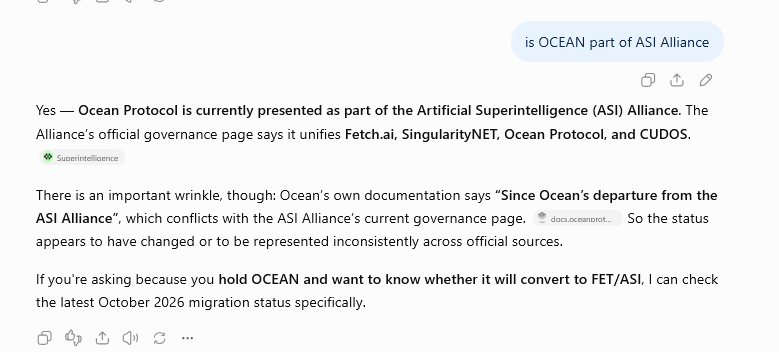
The stale description here isn't buried in an old paper. It sits on an official site, so the model leads with it. Ocean's own correction is out there too, and it comes second. An agent working from that answer would start with the wrong picture of who belongs to the alliance.
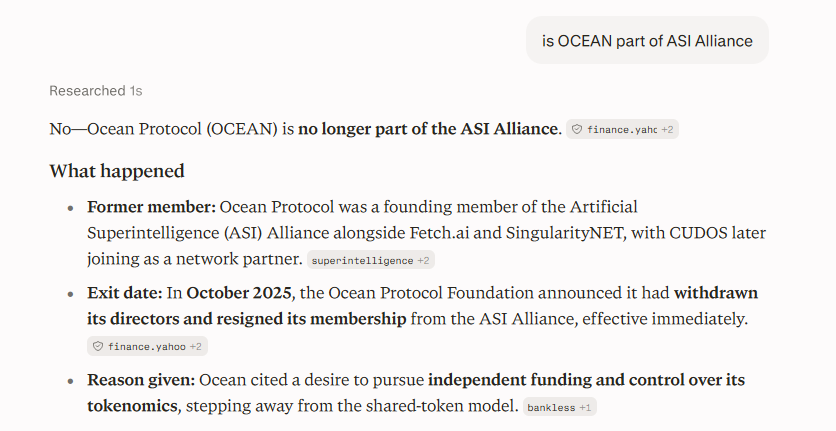
Perplexity got it right. Same question, and its first word was no. It built the answer from news coverage of the exit, including Yahoo Finance and Bankless, and used the alliance's site only for the history.
Claude also said no, after a quick web search. Its only sources were two articles from The Block on the exit.
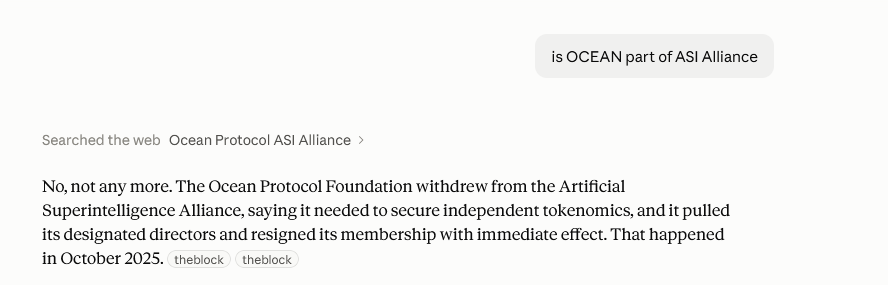
Three platforms, a year after the event. I ran these tests in each platform's public app, not through Robinhood's agents, so they show what the underlying models lean towards, not what an agent did on a trade. The two that got it right built their answers from news coverage. The one that got it wrong trusted the official page. And Robinhood's agents run on OpenAI or Anthropic models, which here gave opposite answers to the same simple question. For a trader, what an agent believes about a token can depend on which model they picked in the settings. And FET, the ASI Alliance's token, is one of the 90 crypto assets Robinhood lets US customers trade.
The ChatGPT row matters more now than it did when I ran the study. A model answering from what it learned in training gives you no source to check. If an agent's opinion of your token comes from that layer, you can't trace where it came from, and you can't ask anyone to correct it.
Schema didn't save anyone either. Pendle was the only DeFi protocol in the sample with JSON-LD markup, and it scored zero. Aave had none and ranked second. Technical fixes on your own site are fine to do. They just weren't what decided who got cited.
The data feeds are a shortlist
The second input is narrower and easier to see. Robinhood's agents can be given extra data through Agent Apps, paid add-ons a user switches on. Eleven providers were live at launch, including Unusual Whales at $30 a month, Nasdaq, SpotGamma, Quiver Quantitative and Token Terminal at $10 a month (Pulse 2.0).
Most of that list is about equities and options. Token Terminal is the only one built around crypto fundamentals: revenue, fees, active users, token incentives.
That makes it a gate. If a trader turns on Token Terminal and asks the agent to compare a few DeFi protocols on revenue, a protocol Token Terminal doesn't track simply isn't in the comparison. Nobody decided to leave it out. It just isn't in the data.
CoinGecko and DefiLlama aren't Agent Apps today. Given how heavily AI systems already lean on them, I'd expect agent platforms to want them, or something like them, soon.
Three things worth checking this week:
- Is your project listed on Token Terminal, and are the metrics shown correct?
- Does your CoinGecko page describe what the project does now, not what it did at launch?
- If you're a DeFi protocol, is your DefiLlama listing complete, with the right chains and categories?
Loops make the shortlist stick
Robinhood says a feature called Loops is coming soon. It turns a strategy into a standing instruction that the agent runs around the clock (Robinhood newsroom).
Think about what that does to research. A one-off question gets a one-off answer. A Loop takes the answer the agent arrived at on day one, the universe of tokens it considered and the data it checked, and keeps acting on it every hour after.
If your project wasn't in that first answer, there's no obvious moment when it gets reconsidered.
Scale that up and the pattern from our study starts to matter. AI attention was already bunched at the top: Ethereum scored 81.9 out of 100, and 6 of the 50 protocols didn't appear on any platform at all. If thousands of Loops start from models with that skew, the same handful of well-covered protocols are likely to come up for consideration again and again, while most of the rest rarely get weighed. A Loop will probably pull fresh prices every time it runs, but only on that same list of projects, unless the sources behind the models change.
The risk Robinhood disclosed itself
Robinhood is not naive about any of this. In its quarterly 10-Q filing with the SEC, the company lists agentic commerce as a source of new regulatory, privacy and cybersecurity risk. It also warns that agents may misinterpret the instructions they're given (Robinhood 10-Q). Robinhood warns that agentic AI could “execute trades without direct customer input.”
The filing is talking about instructions. The same weakness applies to facts. An agent that can misread "buy if it dips 5%" can also misread what a protocol does, or whether its token unlock happened last year or is still coming.
This has already gone wrong in public. In February, an experimental crypto agent called Lobstar Wilde, built by an OpenAI employee, tried to send a stranger on X a tip worth 4 SOL. It sent 52.4 million of its own LOBSTAR tokens instead, about 5% of supply and roughly $250,000 at the time (The Block). The likely cause was the agent misreading the token's decimal places (Yahoo Finance).
Lobstar Wilde had no brokerage account behind it, and it isn't a Robinhood agent. But it demonstrates that an agent got one basic fact about a token wrong and acted on it in seconds.
Manual approval is on by default, and it's a real safeguard but weaker than it looks. A trader approving a proposal sees the agent's summary, not the sources behind it, and AI mistakes rarely look like mistakes. They arrive fluent and confident, the way ChatGPT's answer on Ocean did. Research on automation bias keeps finding that people follow incorrect AI recommendations even after being told the system makes errors (PubMed Central study), and that less experienced users are more prone to it (Radiology Business). There's a simpler point too. Traders who want to check every claim behind every trade aren't the ones handing their research to an agent. For most users, approval will likely mean reading the summary and clicking approve.
Robinhood's terms put the responsibility in one place. A Finder review of agentic trading fine print, distributed by Stacker, found that Robinhood customers carry all the risk for trades their agent makes, and that Robinhood doesn't supervise or audit connected agents (Stacker). That's a sensible position for a broker. It leaves the accuracy of what the agent believes about your project with you, because nobody else in the chain is paid to fix it.
What a founder can check this month
Founders often ask how they get onto a platform like Robinhood. But what an agent will say about them once they're there is every bit as important.
Here's where I'd start.
- Ask the models directly. Run the questions a trader would ask ("what does X do", "compare X and Y on revenue") through ChatGPT, Claude and Perplexity. Write down what's wrong or missing.
- Fix your data-feed listings. Token Terminal, CoinGecko and DefiLlama are the sources an agent is most likely to reach for. Make sure each one is listed and accurate.
- Read your third-party coverage. Search YouTube and Reddit for your project name. If the top explainer is two years old and describes a token model you've since changed, that's the version models learned.
- Earn new coverage on crawlable pages. Our study found third-party coverage, not on-site markup, separated the visible protocols from the invisible ones. Interviews, data-led write-ups and listings on sites AI systems already cite are the work that moves this.
- Make your own pages the best source on you. Your site rarely gets cited directly, about 1% of Perplexity citations in our study, but it's where third-party coverage starts. Journalists, YouTube explainers and data aggregators build their descriptions of you from your docs. If those pages are thin or out of date, everything written from them carries the same gaps. Clear, detailed, current pages are the raw material for the coverage that does get cited.
- Re-test monthly. Model answers change. Keep the same prompt set and track what shifts.
One honest limit. Robinhood's agents can only trade the crypto Robinhood lists, and Robinhood lists 90 crypto assets for US customers (Robinhood). That's a small slice of the market. The knowledge problem is wider. It applies anywhere an agent does research, and agentic trading won't stay on one app for long.
Robinhood's own listings page shows money already changes hands around access. Of the 90 crypto assets it lists, 17 carry a disclosure that Robinhood received an integration fee in connection with supporting them, many of them recent additions (Robinhood). Nothing suggests those fees affect what an agent recommends, and plenty of recent listings carry no fee at all. But which tokens are available to trade is already partly a commercial question, and that's the set of tokens an agent can choose from.
Frequently asked questions
Can Robinhood's AI agents trade any crypto token?
No. They can only trade assets Robinhood lists, and only with funds in the separate agentic account. Manual approval of trades is on by default.
Do AI trading agents read a project's website?
Sometimes, but don't count on it. An agent works from what its model learned in training, the data sources connected to it, and live web browsing. In our study, official project pages made up about 1% of Perplexity citations and 4% of Google AI Overview citations.
How do I find out what AI models say about my project?
Ask them, using the questions a trader or investor would ask, and record the answers and any sources cited. Repeat the same set monthly so you can see what changes.
Does schema markup help AI agents find my project?
Not on its own. In our 50-protocol study, 74% of protocols had no JSON-LD at all, and the only DeFi protocol with it, Pendle, scored zero. Third-party coverage made the difference.
For most of crypto's history, a trader found a project, then researched it. With agents, the research comes first, and it happens before the trader ever sees the name. What goes into that research is mostly written by other people: YouTube explainers, Reddit threads and data aggregators. The projects that check what those sources say, and fix it, are the ones an agent will be able to describe.
Want to know what AI models say about your project?
CryptoContent.dev reviews how ChatGPT, Claude and Perplexity describe crypto and Web3 projects, which sources they rely on, and what to fix first, then builds the content that earns third-party coverage.
View services